Transposing Instruments
Transposing instruments are so called because they are notated differently from how they actually sound. The piano and violin are examples of non-transposing instruments. On these instruments, what you see is what you get; i.e. when it says C in the sheet music, you play a C, and the actual sound is a C. Non-transposing instruments are said to be "in C", since C is the first letter of the musical alphabet.
However, there are instruments where a notated C yields a different sounding note. For instance, if you play written C, what comes out of the instrument is a lower B flat, a higher E flat, or even the E flat an octave and a major sixth below! These instruments are called transposing instruments, and music written for them has to be written in the "wrong key", as it were.
There are two reasons why an instrument is written in transposition:
- It is part of a large family of instruments with similar construction but different registers, e.g. the flute or the clarinet. A written note in the sheet music always refers to the same fingering on the instrument, meaning a musician can double on several different instruments without having to mentally reset in-between.
- The instrument has an awkward in-between range that would nominally require frequent clef changes, or excessive amounts of ledger lines. Thus it is transposed an octave up or down for convenience.
Thus we can conclude that instruments under 1) are transposing instruments and those that fall under category 2) are sort of transposing instruments.
The Guitar in Staff Notation
All this talk about transposing instruments is only relevant in my world of music theory because the guitar is a transposing instrument.
Guitar music is always written one octave higher than it sounds, putting it squarely in category 2) above (a sort of transposing instrument). This is done so that the range of the classical guitar can be fitted onto one staff without the excessive use of ledger lines. Here are the open strings of the guitar when notated traditionally:
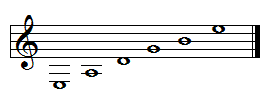
Now compare that to if we were to write guitar music as it actually sounds, which requires the use of the bass clef, because of the comparatively low register of the instrument:
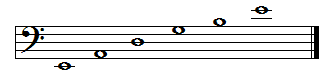
As you can see, the open top E string is already on the second ledger line. Most classical instruments have necks that join the body at the 12th fret, an octave above that, and electric guitars can have 24 or more frets. This would essentially mean separate clefs for rhythm and solos, lots of 8va/8vb or a second staff of ledger lines.
The Bass Guitar
Bass guitar is also notated an octave higher than it sounds, which resonates neatly with traditional orchestral practice—e.g. the double bass.
Retuning
A guitar that is retuned becomes a transposing instrument under category 1) above. The music is still written as if for standard pitch, so as to maintain the coordination between written notes and fingerings. For instance, a guitar that is tuned down by 1½ steps sounds a minor third below expected, and a minor tenth below the notation.
This principle applies only where all strings are retuned by the same amount. Drop-D tuning is written as standard, but the range of the guitar is obviously extended by a major second. A drop-C tuning is a drop-D tuning transposed down two semitones and sounds a major ninth below as written.
Seven-, eight- and 12-string guitars are written as six-string guitars, allowing for retuning where applicable.