Notes
Notes are individual pitches, the smallest indivisible elements of music. The term applies both to pitches as they sound on an actual musical instrument, as well as to the symbols used to represent them in musical notation.
Notes are combined in various ways to form chords and scales, which are the principles behind the fundaments of music: melody and harmony.
Note Names
Natural Notes
Western music uses 12 notes. Of these notes, seven have their own distinct names and are referred to as natural notes. The names we use for them are C, D, E, F, G, A and B. Here is a representation of them in the same order using traditional music notation:
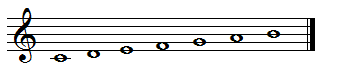
The natural notes correspond to the white keys of a typical piano keyboard:
| |
|
|
|
|||||||||||||
| C |
D |
E |
F |
G |
A |
B |
||||||||||
Enharmonic Notes
The other five notes, corresponding to the black keys, are collectively referred to as enharmonic notes. This means that they sound the same but can be written in different ways. Enharmonic notes have no names of their own, but are considered to be related to nearby natural notes. As you see, there is only one key between C and D. This note can either be considered as related to C or D, depending on the context:
| C# Db |
D# Eb |
F# Gb |
G# Ab |
A# Bb |
||||||||||||
| C |
D |
E |
F |
G |
A |
B |
||||||||||
To indicate that a natural note has been raised or lowered by a half-step, a sharp (#) or flat (b) sign is added to the note:
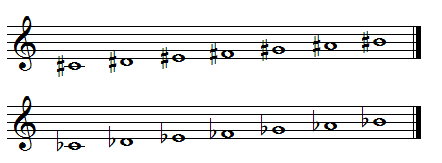
For example, the note between C and D can be referred to either as C sharp (C#, for short) or D flat (Db).
Since any natural note can be assigned a sharp or flat sign, even some of the natural notes have enharmonic equivalents:
| C# Db |
D# Eb |
F# Gb |
G# Ab |
A# Bb |
||||||||||||
| B# C |
D |
Fb E |
E# F |
G |
A |
Cb B |
||||||||||
Double Sharps and Flats
Notes can also be raised or lowered by two half-steps. The double-sharp sign is similar to a lower-case X, the double-flat sign looks exactly the way the term sounds:
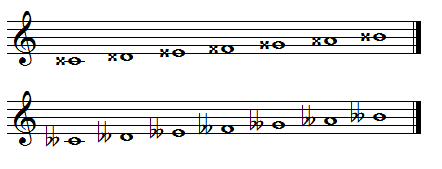
In the same fashion, a C can also be rewritten as a D double-flat (Dbb), whereas a D might occur as a C double-sharp (Cx).
When double flats and sharps are used, most notes—natural or enharmonic—have two enharmonically equivalent notes:
| Bx C# Db |
Fbb D# Eb |
Ex F# Gb |
G# Ab |
Cbb A# Bb |
||||||||||||
| Dbb B# C |
Cx Ebb D |
Dx Fb E |
Gbb E# F |
Fx Abb G |
Gx Bbb A |
Ax Cb B |
||||||||||
Out of context, what to call a given note is mostly irrelevant, especially on instruments with equal temperament. However, in the context of a chord, scale or key, correct spelling is important. This is because our system of music notation is based on a system where scales have seven notes. The extra names are sometimes necessary for an uncluttered and logical note picture.
Pitch Notation
| |
|
|
|
|
|
|
|
|
|
|
|
|||||||||||||||||||||||||||||||||||||||
| C |
D |
E |
F |
G |
A |
B |
C |
D |
E |
F |
G |
A |
B |
C |
D |
E |
F |
G |
A |
B |
||||||||||||||||||||||||||||||
An interesting property of music is that two notes whose frequency are at a 1:2 ratio are very similar. Indeed they are the same notes, but in different registers. The 1:2 frequency relationship is called an octave, because in the system of seven-note scales, the eighth note is where the scale restarts.
The illustration above shows that the 12 notes recur, from the lowest of lows to the very top of the register. After B, there is yet another C and so it continues. In order to tell these different registers, or octaves, apart, we use something called pitch notation. There are many ways to notate pitch, but the prevaling method is scientific pitch notation, where the lowest C on a grand piano is C1 and the notes below that C are termed A0, Bb0 etc.:
| Abbreviation & range | Name |
|---|---|
| C0-B0 | |
| C1-B1 | Double-pedal |
| C2-B2 | Pedal |
| C3-B3 | Bass |
| C4-B4 | Middle |
| C5-B5 | Treble |
| C6-B6 | Top |
| C7-B7 | Double-top |
| C8-B8 | Triple-top |
Pitch Class
Most of the time in music theory, the exact pitch or register of a note is irrelevant. The term pitch class refers not to a specific C among the various registers available on an average instrument, but to all of them collectively. A pitch class, therefore, is any C, D, F, A flat, etc., irrespective of register.
Throughout the following articles, I will consistently use the word note unless pitch class makes more sense in context.