Intervals
In music theory, an interval is the relationship between two pitches (notes) that are played simultaneously or in sequence. If the distinction is important, the former is defined as a harmonic interval, whereas the latter is a melodic interval.
There are many ways to calculate the relationship between pitches. In acoustics, their frequency ratio is important. When discussing various tuning systems, intervals are frequently described in cents where an octave is exactly 1200 cents and an equally tempered semitone is 100 cents.
Most of the time in music theory, however, intervals are measured in how many semitones and scale degrees separate the notes.
Interval Names
The names of intervals are derived from how many scale steps (or degrees) they encompass:
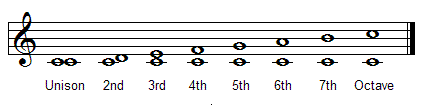
Note that most interval names are simply ordinals—the exceptions being the unison and the octave. (The latter of which anyway means "eighth".)
There are also intervals larger than the octave, commonly referred to as compound intervals:
| Compound interval | Consists of |
|---|---|
| Ninth | Octave + 2nd |
| Tenth | Octave + 3rd |
| Eleventh | Octave + 4th |
| Twelfth | Octave + 5th |
| Thirteenth | Octave + 6th |
| Fourteenth | Octave + 7th |
| Fifteenth | Double octave |
Counting and Adding Intervals
When determining the interval name, the first step is always counted. Hence, the interval C/E is a third, because C=1, D=2 and E=3. This has consequences when adding intervals to each other, for instance when stacking thirds to create chords.
In interval theory, we use a slightly counterintuitive type of addition. Since the lower note of the interval is always counted as 1, the addition of intervals add up to one fewer than expected. If you add a second to a second, you don't get a fourth, but a third. Similarly, stacking a third on top of a third yields a fifth.
Interval Quality
Having determined the name of an interval, its quality is decided by how many semitone steps the interval contains. Since the diatonic scale contains both semi- and whole-tone steps, intervals can appear in two or more forms:
| Semitones | Interval |
|---|---|
| 0 | Perfect unison |
| 1 | Minor 2nd |
| 2 | Major 2nd |
| 3 | Minor 3rd |
| 4 | Major 3rd |
| 5 | Perfect 4th |
| 6 | (See below.) |
| 7 | Perfect 5th |
| 8 | Minor 6th |
| 9 | Major 6th |
| 10 | Minor 7th |
| 11 | Major 7th |
| 12 | Perfect octave |
In contrast to the naming process described above, the starting note is not counted. The interval C to E is a third because C=1, D=2 and E=3 scale steps. It is a major third because C=0, C#=1, D=2, D#=3 and E=4 semitones.
As you can see, the simplest intervals appear in only one basic form, whereas the second, third, sixth and seventh may appear in either minor or major forms. The unison, octave, fifth and fourth are collectively named perfect intervals. They can never become major or minor. Neither can a second or a third ever become a perfect interval.
Altering Intervals
When either or both notes are modified with an accidental (or through a key signature), the semitone span of the interval changes. Such an interval is said to be altered.
A perfect interval becomes diminished when it shrinks by one semitone and augmented when it grows by the same amount:
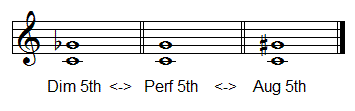
A minor interval that is raised by a semitone becomes a major interval. If it is further raised, it becomes augmented.
A major interval that is flattened by a semitone becomes a minor interval. If flattened further, it becomes diminished.
This is an example of how a minor/major interval grows from diminished to augmented:
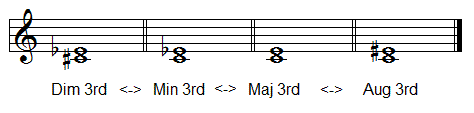
Note how subtracting a sharp is the same thing as adding a flat, and the other way around. Intervals are grown by raising the upper note and/or flattening the lower note. Conversely, they are shrunk by flattening the upper note and/or raising the lower note.
Diminished and augmented intervals that are further altered become double diminished/augmented, then triple diminished/augmented, and so on. Still, a major/minor interval can never become perfect, and vice versa.
Intervals and Enharmonicity
When you add altered intervals to the mix, you have several ways of notating what on an instrument with equal temperament would sound exactly the same. The following is a table of intervals that commonly occur in actual music:
| Semitones | Interval |
|---|---|
| 0 | Unison |
| 1 | Minor 2nd |
| 2 | Major 2nd |
| 3 | Minor 3rd/Augmented 2nd |
| 4 | Major 3rd |
| 5 | Perfect 4th |
| 6 | Augmented 4th/Diminished 5th |
| 7 | Perfect 5th |
| 8 | Minor 6th/Augmented 5th |
| 9 | Major 6th/Diminished 7th |
| 10 | Minor 7th/Augmented 6th |
| 11 | Major 7th |
| 12 | Octave |
This table can be expanded virtually indefinitely by adding all sorts of altered, double-altered and triple-altered intervals, for a great many enharmonically equivalent intervals of barely more than academic interest. For instance, you might construct a triple-diminished third between C double-sharp and E double-flat, or a diminished second between C sharp and D flat. Both these intervals sound in unison on an equally-tempered instrument. Still, so long as the underlying notes are C/E and C/D, respectively, the intervals can never be regarded as anything other than a third and a second, respectively.
On the other hand, if you play the notes C and E on a musical instrument, those notes are simply two notes at the interval of four semitones. Until you place them within the context of a chord or a key, C could just as easily be a B sharp; E could equally well be an F flat. Since the interval name depends on the underlying natural notes, this interval could be anything. It is more likely to be a major third, but without a context, no one can say for sure.
Interval Inversion
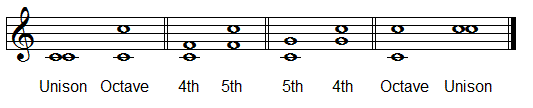
Inverting intervals means that you transpose either of the notes by an octave so that the note that was formerly at the bottom is now on top or vice versa:
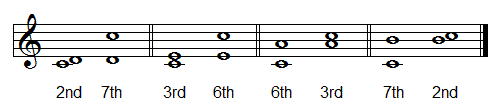
Interval Class
As you see, intervals tend to appear in discrete pairs with similar properties. Unisons and octaves can be thought of as aspects of each other, likewise with fourths and fifths, seconds and sevenths and thirds and sixths. For this reason, theorists sometimes discuss interval classes rather than intervals proper. Just as with pitch classes, register is ignored and the shortest possible distance between notes is calculated.
Inversion of Quality
A major interval that is inverted always becomes a minor interval. Conversely, a minor interval becomes major upon inversion. Altered intervals work exactly the same: an augmented interval inverts to a diminished interval, and the other way around:

The exceptions are the perfect intervals. These remain perfect even in inversion.
The Tritone
The diminished fifth/augmented fourth between B and F is the only interval between natural notes that isn't perfect, major or minor. This interval is known as the tritone, since it spans three whole-tone steps.
The tritone has many interesting properties. It consists of six semitone steps, which means that it is a subdivision of the octave into two parts of equal size. It is also the only interval that remains identical when inverted. Since it is midway through the octave, it is also the largest possible interval class—the perfect fifth (7 semitones) inverts to a perfect fourth (5 semitones).
Learning the Intervals
Music theory and practice becomes a great deal easier if you can name intervals off the top of your head. If someone says B and F sharp, you should instinctively grasp that someone is talking about a perfect fifth. This makes chord and scale construction infinitely easier. Trust me when I say that after intense study and practice, it should fall into place on its own.
But if you are unsure, remember that it is always okay to use memory aids. Strip away the accidentals and start with the underlying natural notes. B to F is what? Count up starting on B=1. C=2, D=3, E=4 and F=5. B/F is a fifth, therefore B/F sharp can only be some form of a fifth. If you remember the previous section, B/F is the only naturally occurring diminished fifth. Therefore, growing a diminished fifth by raising the upper note yields a perfect fifth.
You can always use the following table and cram the intervals between the natural notes just like you did with the multiplication table:
| C | D | E | F | G | A | B | |
|---|---|---|---|---|---|---|---|
| C | Unison | Major 2nd | Major 3rd | Perfect 4th | Perfect 5th | Major 6th | Major 7th |
| D | Minor 7th | Unison | Major 2nd | Minor 3rd | Perfect 4th | Perfect 5th | Major 6th |
| E | Minor 6th | Minor 7th | Unison | Minor 2nd | Minor 3rd | Perfect 4th | Perfect 5th |
| F | Perfect 5th | Major 6th | Major 7th | Unison | Major 2nd | Major 3rd | Aug 4th |
| G | Perfect 4th | Perfect 5th | Major 6th | Minor 7th | Unison | Major 2nd | Major 3rd |
| A | Minor 3rd | Perfect 4th | Perfect 5th | Minor 6th | Minor 7th | Unison | Major 2nd |
| B | Minor 2nd | Minor 3rd | Perfect 4th | Dim 5th | Minor 6th | Minor 7th | Unison |