Chord Theory
A chord is the simultaneous or sequential sounding of three or more different pitch classes.
Perception
Our ears are conditioned to look for and identify chords even where there are none. Even an unaccompanied melody might have implied chords, or the melodic contour might spell out a chord. A texture of several melodies being played simultaneously might give rise to the impression of chords.
Similarly, a single isolated note might very well carry with it a chord association. And even though the dictionary definition of a chord is at least three pitches, chords can be strongly hinted at even when only two pitches sound at the same time.
Triads
With 12 available notes, any three of which can be used to construct a seemingly correct chord, one would think that the possibilities are unlimited. That they are, but over the past few hundred years, musical practice and experience have tended to prefer certain methods of building chords.
What we normally perceive as valid chords are in fact tertian chords, i.e. they are built by stacking thirds on top of each other. The by far most common chords are called triads, which is Greek for three-note chords. The notes that make up a chord are called chord members and take on names from at which intervals the upper notes fall in relation to the first note.
- The root note is the most important note of the chord, the harmonic anchor if you will.
- The third is the second most important note. It determines whether the chord is a major or minor chord.
- The fifth adds fullness to the chord.
- Further notes are added as needed in order to add coloration to the chord.
I like saying that the root gives the chord its identity and the third and fifth its personality.
A possible explanation behind the tertian construction of chords might be the harmonic overtone series, where the fourth, fifth and sixth partials spell out a tertian chord.
Basic Triads
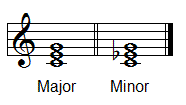
The two most important triads are the major and minor triads. In addition to the root note, both have a perfect fifth. The difference between the chords is the third. If it is major, it is a major triad, if it is a minor third, it is a minor chord:
Altered Triads
There are also four possible altered triads, meaning that the fifth has been lowered or raised, for a slightly dissonant sound. There are two altered minor triads and two altered major triads, one of each of whom are more prominent in music theory: the diminished triad and the augmented triad:
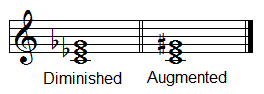
As you can see, the diminished triad has a minor third and a diminished fifth. The augmented triad has a major third and an augmented fifth.
Triad Interval Structure
- Major and minor triads span a total of seven semitones.
- The major triad is built from 4 + 3 semitones, since it consists of a major third and a minor third.
- The minor triad is built from 3 + 4 semitones; the proportions are reversed.
- The diminished triad is made up of six semitones (3 + 3), or two minor thirds.
- The augmented triad is made up of eight semitones (4 + 4), or two major thirds. The augmented triad is symmetrical, because there are then four semitones between the augmented 5th and the octave. This means that the intervals remain the same upon inversion (more on that later).
The other two possible altered triads are the minor augmented fifth triad, and the major diminished fifth triad. These are not that common, mostly due to the fact that the former has an interval structure that is enharmonically equivalent to a first-inversion major triad (see below). The latter is close to secundal harmony (as opposed to tertian) due to the diminished third (2 semitones) between the upper two chord members.
Another reason might be that such altered chords regularly show up in larger chord constellations, their sonorities rendered more pungent by the addition of a seventh or maybe even a ninth. (More below.)
Four-note Chords
In order to follow the Greek theme, you could always refer to chords with four notes as tetrads, and five as pentads, and so on. In actuality, we discuss triads and then move on to the decidedly less romantically named four-note chords, five-note chords, et cetera.
Seventh Chords
A seventh chord is a triad with the addition of a seventh. There are two basic triads and you can add either a minor or a major seventh. This gives us four basic seventh chords:
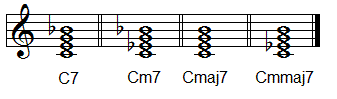
All of these can be thought of as colorations of the basic triads. The only chord that has any function in classical harmony, however, is the major triad with a minor seventh. This is the seventh chord, which can be more specifically referred to as a dominant seventh chord.
When you study chord symbols, you will find that the seventh is the only upper note that isn't found naturally in the major scale. The explanation lies in classical harmony, where the dominant chord occurs on the fifth of the scale. If you build a tertian chord on this scale degree instead of the tonic, the minor seventh occurs naturally in the key:
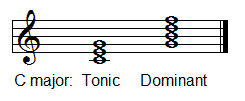
Look ma—no accidentals!
Diminished Seventh
Diminished seventh chords are very special. They consist of a diminished triad to which you add—not a minor but a diminished seventh.
Dim7 chords have all sorts of interesting properties. First and foremost, they are perfectly symmetrical. There are three semitones between each chord member, and when you stack yet another minor third on top of the diminished seventh, you will find yourself back at the octave! This means that any of the notes in the chord can be regarded as the root.
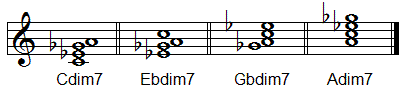
A careful scrutiny of the above music example will reveal that I have taken the liberty of making some enharmonic substitutions in the interest of clarity. B double-flat sounds just like A on an even-tempered instrument.
Sixth Chords
A sixth chord is a major or minor triad with the addition of a major sixth:
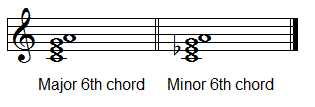
There are a couple of peculiarities with sixth chords. First of all, they are not tertian chords—as you can clearly see in the music example above, the interval between the fifth and sixth is a major second. Second, the chord always contains a major sixth, even if it's a minor chord.
In functional harmony, sixth chords appear primarily on the IV chord, a.k.a. the subdominant. As part of a cadence, the sixth in a IV6 chord is an anticipation of the fifth in a V7 (dominant seventh) chord that leads back to the I chord or tonic. This note is the second note of the scale, which is the same interval in both minor and major modes.
Extended and Altered Chords
Extended Chords
Chords with five or more notes are spread out over more than an octave and are therefore known as extended chords. All extended chords continue the principle of stacking thirds on top of the root:
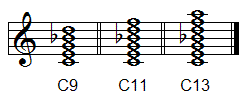
- A ninth chord is a seventh chord with an added ninth.
- An eleventh chord is a seventh chord with an added ninth and eleventh.
- A thirteenth chord is a seventh chord with an added ninth, eleventh and 13th. It also looks like it's going to require your entire forearm to play.
When you get to a 13 chord, all seven scale degrees are present in the chord, so no further stacking of thirds is possible. (Or, to quote Nigel Tufnel from Spinal Tap, "by the time you get to 13 the song's over anyway".) There are no 15th chords, because a 15 is a double octave.
Altered Chords
Altered chords are chords where the fifth and/or any of the extension notes (9th, 11th or 13th) has been chromatically altered. These chords will be discussed in a bit more detail in the essay on chord symbols.
Voicing and Inversion
Voicing
A chord voicing is how you space the chord on one or more musical instruments or voices. The voicing determines if any or all of the chord members are doubled, in which register (or octave) they are situated, and which chord member is the bass note.
All the following chords are perfectly valid voicings of a C major triad:
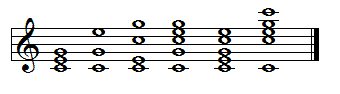
The first and fifth voicings are in close position, i.e. there are as few musical gaps between notes as physically possible. The others are in open position, i.e. with more separation between the notes.
The first two voicings contain only the chord members C, E and G, but the third through sixth voicings have one or more doubled notes. Which notes are doubled and/or placed in the most prominent top voice, determines the character of the chord:
- Doubling the root note reinforces the tonal identity of the chord.
- Doubling the third reinforces the minor/major character.
- Doubling the fifth adds fullness to the chord.
Inversion
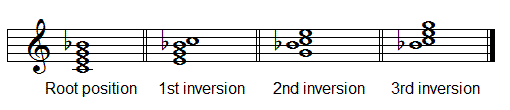
If the root note is the bass note, i.e. it is the lowest note in the chord and all other notes are played higher up, the chord is said to be in root position. If any other note is the bass note, the chord is considered to be inverted.
Triads have two possible inversions, since there are two notes other than the root:
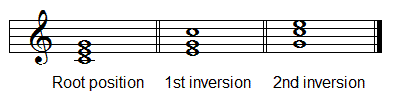
Four-note chords have three, since there is also a seventh:
Chord Relations
Relative chords are chords that are situated three semitones apart and have two notes in common. This always falls so that the major chord is a minor third above the minor chord:
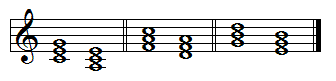
As you can see, the C major triad is relative with A minor (C and E in common), F with Dm (F and A in common) and G with Em (G and B in common).
In C minor, it looks like this:
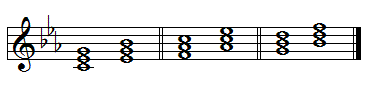
The C minor triad is related to Eb major (E flat and G in common), Fm with Ab (A flat and C in common) and Gm with Bb (B flat and D in common).
Thus, the upper two notes of the minor chord are common with the lower two notes of the major chord.
This relationship with two notes in common also exists in the other direction. A major triad also has two notes in common with the minor triad that is situated a major third above it:
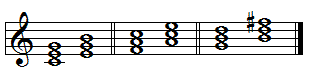
The C chord has E and G in common with Em. F has A and C in common with Am. G has B and D in common with Bm. (Even though this chord requires a bit of cheating with a sharp in order to make it an unaltered minor triad.)
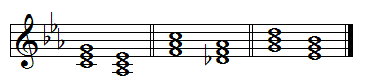
In C minor above, the Cm triad has C and E flat in common with the Ab triad. Fm has F and A flat in common with Db (which also requires fudging with a flat accidental). Gm has G and B flat in common with Eb.
This relationship has been identified by some theorists as an "opposite" or "counter-relative" chord. It is also referred to as a leading note exchange chord, since the chords are only separated by a leading note (C = C E G, Em = E G B.)